

Quick Answer: How Does Blood Detection Testing Work?
Blood detection testing is used to determine whether blood is present on an item. Confirmatory methods such as RSID Blood testing use immunological detection of the human-specific protein glycophorin A to help confirm the presence of human blood on clothing, personal items, and other submitted materials.
In This Article
What is blood detection testing?
What does RSID Blood detect?
What is glycophorin A?
Confirmatory vs presumptive blood testing
What items can be tested?
Can blood detection be combined with DNA testing?
What Is Blood Detection Testing?
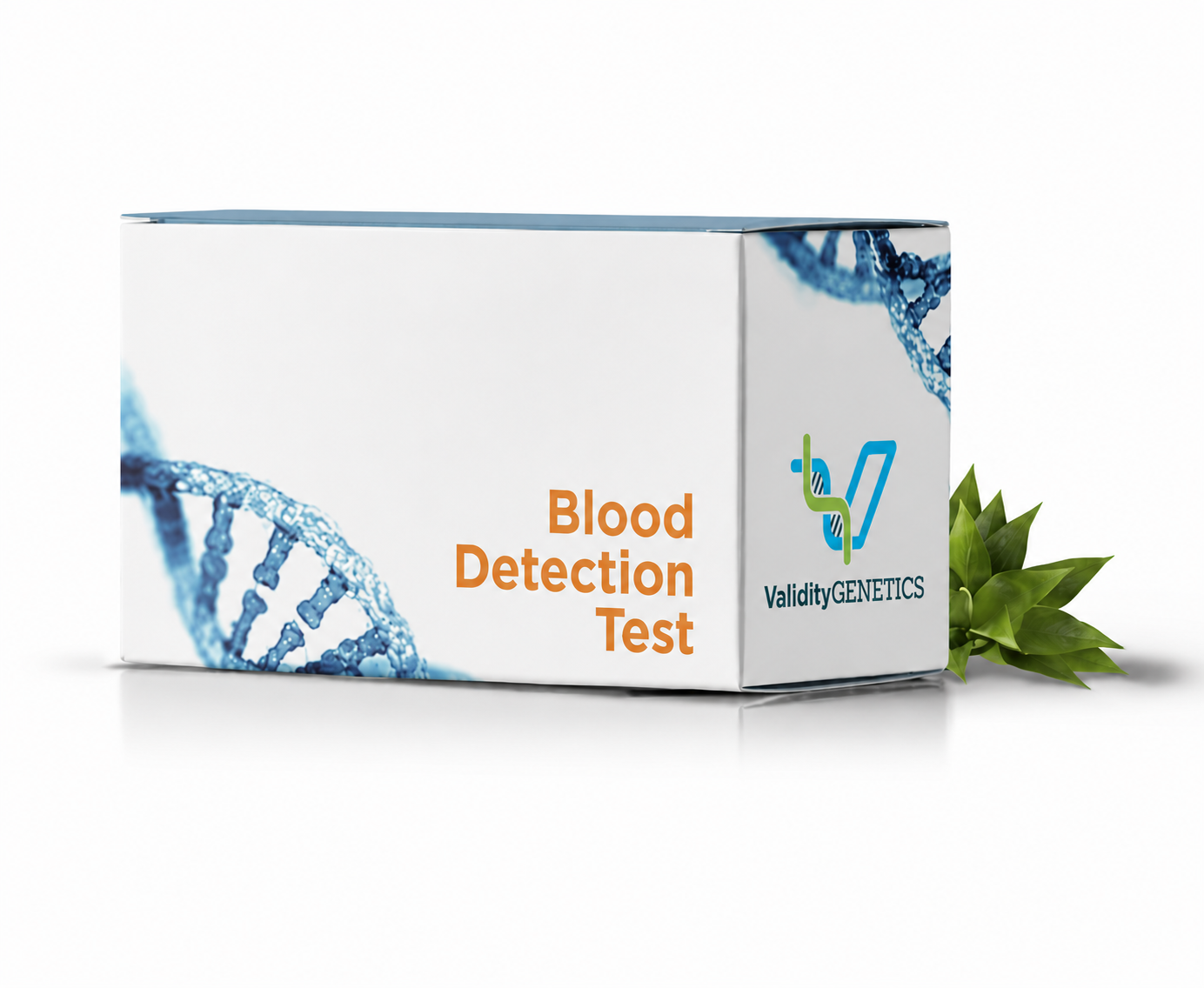
This is not a physical product. This is a service.
We do NOT ship anything to you for this test.
You must ship your items/samples to our laboratory.
Blood detection testing is a laboratory procedure used to determine whether blood may be present on an item.
This type of testing may be performed on:
clothing
bedding
personal items
fabrics
tissues
other materials suspected of containing blood
The goal is to identify biological evidence that may not be visible or easily recognized.
What Does RSID Blood Detect?
The blood detection test offered by Validity Genetics uses RSID Blood, a confirmatory testing method designed to identify the human-specific protein glycophorin A.
Glycophorin A is found on the surface of human red blood cells and serves as a biological marker that helps laboratories determine whether human blood is present on a tested item.
When glycophorin A is detected, the findings support the conclusion that human blood may be present.
What Is Glycophorin A?
Glycophorin A is a protein located on the membrane of human red blood cells.
Because it is strongly associated with human blood, it can be used as a target for laboratory testing designed to identify blood evidence.
By detecting glycophorin A, laboratories can distinguish blood evidence with greater specificity than many preliminary screening methods.
Confirmatory vs Presumptive Blood Testing
Not all blood tests provide the same level of information.
Understanding the difference between presumptive and confirmatory testing is important when evaluating results.
Presumptive Blood Tests
Presumptive tests are designed to indicate that blood may be present.
Examples include:
Kastle-Meyer testing
Hemastix testing
Luminol screening
These methods are useful screening tools but may react with substances that produce similar chemical responses.
As a result, presumptive tests are generally considered preliminary indicators.
Confirmatory Blood Tests
Confirmatory tests are designed to identify blood with greater specificity.
RSID Blood testing uses immunological detection of glycophorin A to help confirm the presence of human blood.
Because this method targets a blood-specific protein, it provides stronger evidence than a preliminary screening test alone.
What Types of Items Can Be Tested?
Many different items may be suitable for blood detection testing.
Examples include:
clothing
bedding
fabrics
personal belongings
tissues
other submitted materials
The success of testing depends on the condition of the item and the biological material available for analysis.
Can Blood Be Detected After Cleaning?
The answer depends on several factors.
These include:
the amount of blood originally present
the cleaning method used
environmental exposure
the condition of the item
Cleaning may reduce biological material, but it does not necessarily eliminate every trace.
Laboratory testing is often required to determine whether detectable evidence remains.
Blood Detection vs DNA Testing
Blood detection testing and DNA testing answer different questions.
Blood Detection Testing
Blood detection testing helps determine whether blood is present on an item.
DNA Testing
DNA testing focuses on recovering and analyzing genetic material from biological evidence.
If sufficient DNA is recovered, scientists may be able to create a DNA profile and compare it to known reference samples.
Learn more about DNA comparison testing here: How DNA Comparison Testing Works
Can Blood Detection Be Combined with DNA Testing?
Yes.
In some cases, blood detection testing may be performed first to determine whether blood is present.
If biological material is confirmed and sufficient DNA is available, additional DNA testing may be possible.
This combination can provide more information than either test alone.
Understanding Blood Detection Testing
Blood detection testing provides a scientific method for identifying blood evidence on clothing, personal items, and other materials. Confirmatory methods such as RSID Blood testing use immunological detection of glycophorin A to help determine whether human blood is present.
Understanding how these tests work helps individuals better interpret results and understand what information blood evidence may provide.
Related Services





Related Articles
How Saliva Detection Testing Works
How Semen Detection Tests Work
How DNA Comparison Testing Works
How Accurate are Infidelity DNA Tests?
Cited References:
National Institute of Justice. DNA Evidence Basics
https://nij.ojp.gov/topics/articles/dna-evidence-basicsAmerican Academy of Forensic Sciences (AAFS)
https://www.aafs.orgInternational Society for Forensic Genetics (ISFG)
https://www.isfg.org

This is not a physical product. This is a service.
We do NOT ship anything to you for this test.
You must ship your items/samples to our laboratory.