
Forensic DNA Relationship Testing
Determine Biological Relationships Using Toothbrushes, Hair, and Other Personal Items
Need a DNA relationship test but can't obtain a traditional cheek swab?
Validity Genetics offers confidential Forensic Relationship DNA Testing using personal belongings and other non-standard DNA samples. Whether you're trying to establish paternity, determine a sibling relationship, or investigate a family connection involving a grandparent, aunt, or uncle, our laboratory partners can attempt to recover DNA from items that may contain genetic material.
Forensic DNA testing may be an option when someone is deceased, unavailable, or unable to participate in conventional sample collection.
We offer multiple testing options, guidance on choosing suitable samples, and confidential results to help you better understand your biological family relationships.
Forensic Relationship DNA Tests start at $269, with standard results generally available within 5–7 business days after laboratory receipt.
What Is Forensic Relationship DNA Testing?
Forensic Relationship DNA Testing is a specialized form of genetic testing that evaluates biological relationships using DNA recovered from non-standard samples.
Traditional relationship DNA tests typically use cheek swabs collected directly from participating individuals. Forensic testing allows our laboratory to attempt DNA extraction from personal items such as toothbrushes, razors, hair with attached roots, or clothing.
Once a usable DNA profile is recovered, it can be compared with DNA from other individuals to evaluate the proposed family relationship.
Forensic testing may be helpful when:
A family member is deceased. Personal belongings may provide an alternative source of DNA.
Someone is unavailable for traditional testing. A previously used personal item may contain recoverable DNA.
A cheek swab cannot be obtained. Non-standard samples may offer another testing option.
You need to investigate a biological family relationship. Testing may help evaluate paternity, sibling, grandparent, or aunt/uncle relationships.
You need confidential testing. Our services are designed to protect your privacy and provide discreet sample submission options.
Because forensic samples vary in quality and DNA content, successful extraction and relationship analysis cannot be guaranteed.
Types of Forensic Relationship DNA Tests Available
Different family relationships require different types of DNA analysis. Choosing the appropriate test depends on the relationship being investigated and which individuals or DNA samples are available.
Forensic Paternity DNA Testing
Determine whether a man is the biological father of a child using DNA recovered from personal items.
A Forensic Paternity DNA Test may be useful when the alleged father is deceased, unavailable, or unable to provide a cheek swab.
Our laboratory can attempt to recover DNA from items such as a toothbrush, used razor, or another suitable personal belonging and compare the resulting DNA profile with the child's DNA.
Direct paternity testing generally provides stronger statistical evidence than indirect family relationship testing when suitable DNA profiles are available.
Starting at $269
Learn More About Forensic Paternity DNA Testing
Forensic Sibling DNA Testing
Evaluate whether two individuals share one or both biological parents.
Forensic Sibling DNA Testing can help evaluate full-sibling or half-sibling relationships when traditional DNA collection is not possible.
This may be useful when one sibling is deceased, unavailable, or unable to participate directly.
Sibling DNA testing uses statistical analysis to evaluate the proposed relationship. Results may be less conclusive than direct paternity testing, especially when distinguishing full siblings from half siblings.
Starting at $299
Learn More About Forensic Sibling DNA Testing
Forensic Avuncular DNA Testing (Aunt/Uncle)
Evaluate a biological relationship between an aunt or uncle and a potential niece or nephew.
A Forensic Avuncular DNA Test can provide information about a possible family connection when a biological parent's DNA is unavailable.
For example, testing a child and the alleged father's biological brother or sister may help evaluate the proposed aunt/uncle relationship.
Including additional known relatives may improve the strength of the analysis.
Starting at $299
Learn More About Forensic Avuncular DNA Testing
Forensic Grandparent DNA Testing
Evaluate a biological relationship between a grandparent and a potential grandchild.
Forensic Grandparent DNA Testing may help investigate family relationships when a parent is deceased or unavailable.
Testing can involve one or both alleged biological grandparents and the potential grandchild. Including both grandparents from the relevant family line may provide stronger statistical evidence.
When a traditional cheek swab is unavailable, DNA may be recovered from suitable personal belongings.
Starting at $299
Learn More About Forensic Grandparent DNA Testing
Forensic Twin DNA Testing
Determine whether twins are identical or fraternal using suitable DNA samples, including non-standard samples when traditional collection is unavailable.
Starting at $259
Learn More About Forensic Twin DNA Testing
Y-STR Paternal Lineage Testing
Evaluate shared paternal-line ancestry using male-specific Y-chromosome DNA markers. This may be helpful in certain family relationship investigations, although men from the same paternal line may share matching Y-STR profiles.
Learn More About Paternal Lineage DNA Testing
Not sure which test is right for your situation? Contact Validity Genetics before ordering, and we'll help you identify the most appropriate testing option




Discreet Forensic DNA Testing Sample Examples
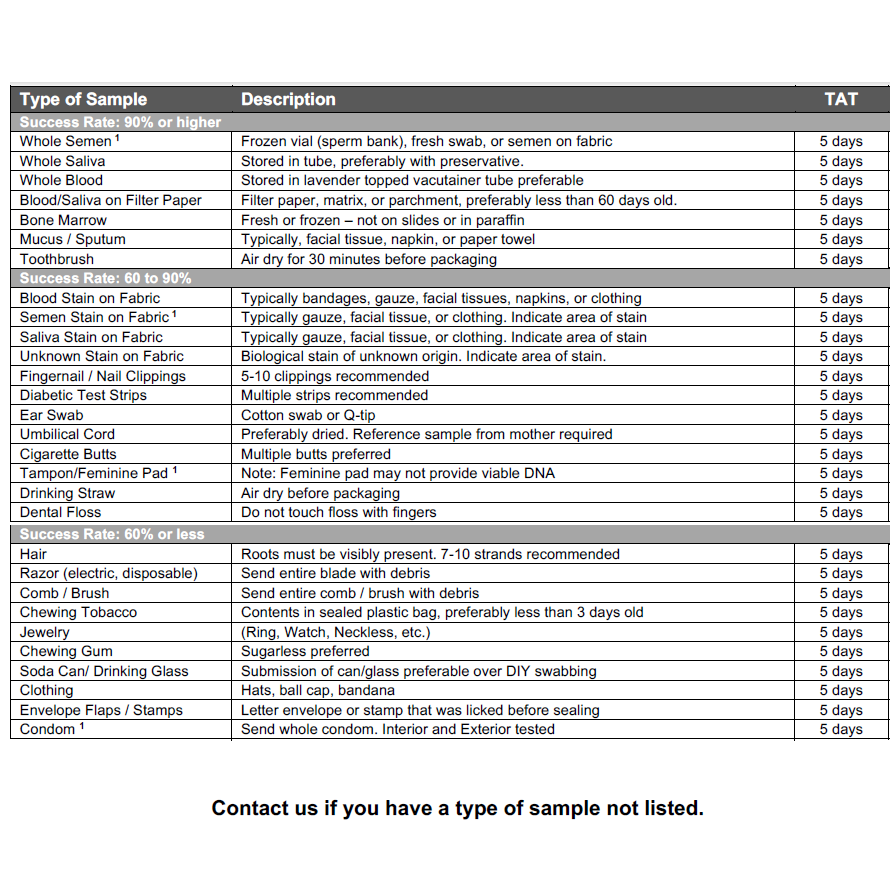
What Types of Personal Items Can Be Used for Forensic DNA Testing?
Many everyday items can contain human DNA. However, the amount and quality of recoverable DNA vary significantly depending on how the item was used, handled, and stored.
Commonly submitted forensic DNA samples include:
Toothbrushes: Often recommended because they may contain a concentrated source of DNA from the user.
Used razors: May contain skin cells or traces of biological material.
Hair with attached roots: Hair roots can contain nuclear DNA suitable for relationship testing. Hair shafts without roots are generally less suitable for standard STR analysis.
Fingernail or toenail clippings: May contain recoverable DNA, depending on sample condition.
Cigarette butts: May contain saliva-associated cells from the person who smoked them.
Chewing gum: May contain saliva and cells suitable for DNA extraction.
Drinking straws and bottles: May contain DNA from contact with the mouth, although shared use can complicate analysis.
Hats, pillowcases, and worn clothing: May contain skin cells, hair, or other biological material.
Dried bloodstains: Can be a source of DNA when suitable biological material remains.
Which Forensic DNA Sample Is Best?
A toothbrush used regularly by one person is often one of the preferred non-standard samples.
However, no particular item guarantees successful DNA recovery.
Samples with limited DNA, extensive handling, environmental exposure, or multiple contributors may produce incomplete or inconclusive results.
Some specialized materials, including bones, teeth, preserved tissue, and certain medical specimens, require separate evaluation and may not be included in standard forensic sample testing.
If you're unsure whether your item is suitable, contact us before submitting it.
How Does Forensic Relationship DNA Testing Work?
Step 1: Choose Your Relationship DNA Test
Select the test that matches the biological relationship you want to evaluate, such as paternity, sibling, avuncular, or grandparent testing.
If you're uncertain, our team can help you determine which test and participants are most appropriate.
Step 2: Collect and Prepare Your DNA Samples
Gather the personal items or other DNA samples needed for testing.
Avoid touching areas likely to contain DNA, and handle each item separately to reduce contamination.
Allow damp items to air-dry before placing them in a clean paper envelope or bag. Do not wash the items or seal damp samples in plastic.
Learn More About Gathering Special DNA Samples
Step 3: Submit Your Samples to Our Laboratory
Follow the collection and shipping instructions provided with your order.
Once the laboratory receives and checks in your samples, you will receive confirmation and information about the expected testing timeframe.
Step 4: DNA Extraction and Relationship Analysis
The laboratory attempts to recover a usable DNA profile from each forensic sample.
When suitable DNA profiles are obtained, they are analyzed and compared to evaluate the proposed biological relationship.
Some samples may require additional processing, and certain items may not yield sufficient DNA for a reliable comparison.
Step 5: Receive Your Confidential DNA Test Results
Standard forensic relationship DNA testing generally takes 5–7 business days after laboratory receipt.
Business days are Monday through Friday, excluding holidays.
Your completed results are delivered confidentially by email in PDF format.
How Accurate Is Forensic Relationship DNA Testing?
Forensic relationship DNA testing uses established genetic profiling methods and statistical analysis to evaluate biological relationships.
When complete, reliable DNA profiles are recovered, testing can provide meaningful evidence supporting or opposing a proposed family relationship.
However, the strength of the results depends on several factors:
DNA sample quality: Degraded or insufficient DNA may prevent a reliable profile from being recovered.
The relationship being tested: Direct paternity testing is generally more conclusive than sibling, grandparent, or avuncular testing.
Available family members: Including additional biological relatives may improve the statistical analysis.
Mixed DNA samples: Items containing DNA from multiple people can complicate interpretation.
Important: We cannot guarantee that a non-standard sample will produce a usable DNA profile or a conclusive relationship result.
Forensic DNA Testing vs. Traditional Home DNA Testing
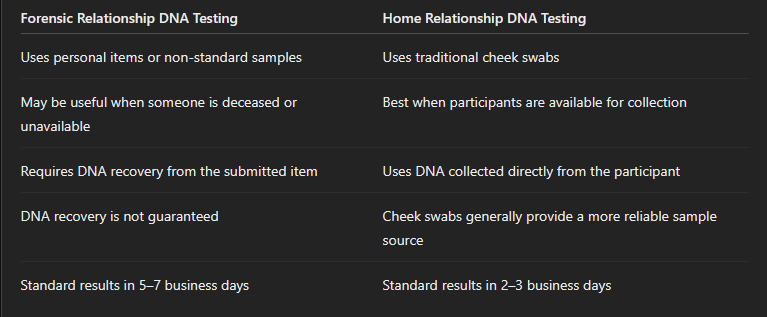
Both forensic and home DNA testing use genetic analysis to evaluate biological relationships, including paternity, sibling, grandparent, and aunt/uncle relationships. The primary difference is how DNA samples are collected and prepared for testing.
Traditional home DNA testing uses cheek swabs collected directly from participating individuals. Forensic DNA testing allows our laboratory to attempt DNA extraction from personal belongings, such as toothbrushes, hair with roots, razors, and other non-standard samples.
The comparison below highlights the key differences between forensic and traditional home relationship DNA testing
Which DNA Testing Option Is Right for You?
If all participants are available and willing to provide cheek swabs, traditional home DNA testing is generally the simpler and more economical option. Standard results are typically available within 2–3 business days after laboratory receipt.
However, if someone is deceased, unavailable, or unable to provide a cheek swab, Forensic Relationship DNA Testing may provide an alternative. Our laboratory can attempt to recover DNA from personal items, with standard results generally available within 5–7 business days after laboratory receipt.
Both time frames refer to business days, Monday through Friday, excluding holidays. Forensic testing may take longer when samples require additional processing.
Not sure which option is appropriate? Contact Validity Genetics before ordering, and we'll help you evaluate the available DNA samples and testing options.
Is Forensic Relationship DNA Testing Legal or Court-Admissible?
Our standard Forensic Relationship DNA Tests are intended for personal knowledge and informational purposes.
Because personal items are generally collected without verified identification and documented legal chain-of-custody procedures, results are not intended for court use.
If you need DNA testing for child support, custody, inheritance, immigration, or another legal matter, we recommend discussing your requirements with an attorney before ordering.
You can also explore our Legal DNA Testing services for information about testing with documented identity verification and chain-of-custody procedures.
Why Choose Validity Genetics for Forensic Relationship DNA Testing?
Experienced Laboratory Partners
We work with AABB-accredited laboratory partners that provide professional DNA analysis and relationship testing services.
Flexible DNA Sample Options
We can evaluate many types of non-standard samples, including toothbrushes, razors, hair with roots, and other personal items.
Confidential Testing
Your privacy matters. We do not share or sell any client, DNA, or testing information with outside parties.
Multiple Relationship Testing Options
From paternity and sibling testing to grandparent and aunt/uncle relationships, we offer options for a variety of family situations.
Helpful Customer Support
Not sure which item to submit or which relationship test to purchase? Our team can help you understand your options before ordering.
Clear Turnaround Times
Standard forensic relationship DNA testing generally takes 5–7 business days after laboratory receipt, with additional processing time possible for challenging samples.
Get Started with Forensic Relationship DNA Testing
When traditional cheek swab testing isn't possible, forensic DNA analysis may provide another way to investigate an important biological family relationship.
Whether you need to evaluate paternity, sibling relationships, grandparentage, or an aunt/uncle relationship, Validity Genetics can help you understand your testing options.
Forensic Relationship DNA Tests start at $269.
Explore the individual testing options above or contact our team to discuss your situation and available DNA samples.
Questions about testing?
Email Info@ValidityGenetics.com for assistance before placing your order.
Forensic Relationship DNA Testing:
Frequently Asked Questions
-
Forensic Relationship DNA Testing evaluates biological relationships between family members using DNA recovered from personal items or other non-standard samples instead of traditional cheek swabs.
Our laboratory can attempt to extract DNA from items such as toothbrushes, hair with roots, razors, and other personal belongings. The recovered DNA profiles are then analyzed to evaluate the proposed biological relationship.
Forensic relationship testing is particularly useful when an individual is deceased, unavailable, or unable to provide a traditional DNA sample.
-
Validity Genetics offers several types of Forensic Relationship DNA Testing, depending on the family relationship you need to establish.
Forensic Paternity DNA Testing – Evaluates whether a man is the biological father of a child using DNA recovered from personal items.
Forensic Sibling DNA Testing – Evaluates whether two individuals are biologically related as full siblings or half siblings.
Forensic Avuncular DNA Testing – Evaluates the biological relationship between an aunt or uncle and a potential niece or nephew.
Forensic Grandparent DNA Testing – Evaluates the biological relationship between a grandparent and a potential grandchild.
The most appropriate test depends on the relationship being investigated and which family members or DNA samples are available.
-
Our laboratory can attempt to recover DNA from a variety of personal belongings, including:
Toothbrushes
Hair with attached roots
Used razors
Fingernail clippings
Certain clothing and personal items
Other objects that may contain recoverable human DNA
Toothbrushes are often a preferred sample because they may contain a relatively concentrated source of DNA from the person who used them.
Not every item will contain sufficient DNA for testing. The amount of recoverable DNA, its condition, and whether multiple people handled the item can affect the results.
-
Yes. Forensic relationship testing may be possible when a family member is deceased, unavailable, or unable to participate in traditional sample collection.
A personal item previously used by that individual may contain recoverable DNA that can be compared with DNA from other family members.
For example, forensic paternity testing may use a deceased father's toothbrush, while forensic sibling or grandparent testing may help evaluate family relationships when a parent's DNA is unavailable.
The laboratory must first recover a suitable DNA profile from the submitted item. Testing cannot be guaranteed for every sample.
-
Forensic relationship testing uses established DNA profiling methods and statistical analysis to evaluate proposed biological relationships.
When complete, reliable DNA profiles are recovered, results can provide meaningful evidence supporting or opposing a biological relationship.
However, accuracy and statistical strength depend on the type of relationship being evaluated, the number of participating family members, and the quality of the DNA samples.
Direct paternity testing is generally more conclusive than indirect relationship testing, such as sibling, avuncular, or grandparent testing. Some results may be inconclusive, especially when samples contain limited, degraded, or mixed DNA.
-
Both testing methods use DNA analysis to evaluate biological relationships. The main difference is how the DNA samples are obtained.
Forensic Relationship DNA Testing uses DNA recovered from personal items or other non-standard samples. It is useful when a traditional cheek swab cannot be obtained.
Home Relationship DNA Testing uses cheek swabs collected directly from participating individuals. It is generally the preferred option when everyone is available and willing to provide a sample.
Home testing typically avoids the additional challenges of extracting DNA from personal belongings and generally has a shorter laboratory turnaround time.
-
Our standard Forensic Relationship DNA Tests are intended for personal knowledge and informational purposes.
Because personal items are generally collected without verified identification or documented legal chain-of-custody procedures, the results may not satisfy court requirements.
If you need DNA testing for child support, custody, inheritance, immigration, or another legal matter, contact Validity Genetics before ordering to discuss the appropriate testing process.
We also recommend consulting an attorney about the requirements for your specific situation.
-
Standard Forensic Relationship DNA Test results are generally available within 5–7 business days after our laboratory receives the samples.
Some non-standard samples may require additional processing time if DNA is degraded, present in small quantities, or difficult to extract.
Results are delivered confidentially by email in PDF format.
-
Choosing the right test depends on the biological relationship you want to evaluate and which individuals or DNA samples are available.
If you need to determine whether a man is the biological father of a child, Forensic Paternity DNA Testing is generally the most direct option.
If the alleged parent's DNA is unavailable, Forensic Sibling, Forensic Avuncular, or Forensic Grandparent DNA Testing may provide alternative ways to evaluate biological family relationships.
Additional participating relatives may strengthen the analysis in some cases.
If you're unsure which test is appropriate, contact Validity Genetics before ordering. We can help you evaluate the available samples and select the most suitable testing option.
Forensic Twin DNA Test (Informational/Home Version) includes:
Easy to follow instructions on how to collect and care for the special samples
Instructions on where to send the Special Samples
2 sterile buccal collection swabs per person (if selected)
Consent form
*Please note Special Samples do not include: Teeth, Bones, Bone Marrow, Organs or Muscle Tissue, Feces, Paraffin Embedded Tissue, or FFPE. *
To test these items or additional questions please contact us.
Please be aware that due to the nature of forensic testing a conclusive result is not guaranteed.
Select from the options below: