
Half Siblings vs Full Siblings: How DNA Tests Tell the Difference

Quick Answer: Can DNA Testing Tell the Difference Between Half and Full Siblings?
Yes, DNA testing can help determine whether two individuals are more likely to be half siblings or full siblings. Sibling DNA tests analyze shared genetic markers to calculate the statistical likelihood of a biological relationship. By comparing how much DNA two people share, laboratories can determine whether they are more likely to share one parent or both parents.
What Is a Sibling DNA Test?
A sibling DNA test is used to determine whether two individuals share one or both biological parents.
There are two types of sibling relationships that DNA testing can evaluate.
Full siblings
Two individuals who share both biological parents.
Half siblings
Two individuals who share only one biological parent.
Sibling DNA testing analyzes specific genetic markers to measure how much DNA two individuals share and calculates the likelihood of the relationship.
When a parent is not available for testing, relationship DNA testing methods such as sibling testing, avuncular testing, or grandparent testing may help evaluate biological connections.
Learn more about these types of tests here: Relationship DNA Testing Explained.

Home Sibling DNA testing kit includes:
Easy to follow instructions,
2 sterile buccal collection swabs per person,
Sample envelopes for each person involved,
Consent form (must be filled out and signed in full),
Prepaid return label to our laboratory. (USA only)
Please note we always suggest including a known parent in testing
Select testing options below:

Forensic Sibling DNA Test (Informational/Home Version) includes:
Easy to follow instructions on how to collect and care for the special samples
Instructions on where to send the Special Samples
2 sterile buccal collection swabs per person (if selected)
Consent form
*Please note Special Samples do not include: Teeth, Bones, Bone Marrow, Organs or Muscle Tissue, Feces, Paraffin Embedded Tissue, or FFPE. *
To test these items or additional questions please contact us.
Please be aware that due to the nature of forensic testing a conclusive result is not guaranteed.
Select from the options below:
How Sibling DNA Testing Works
Sibling DNA testing typically uses autosomal DNA markers, which are inherited from both parents.
Each person inherits:
Half of their DNA from their biological mother
Half of their DNA from their biological father
By comparing these markers between two individuals, laboratories can determine how much genetic material they share.
In general:
Full siblings share more DNA
Half siblings share less DNA
The laboratory uses statistical analysis to determine which relationship is more likely.
The Role of the Siblingship Index
DNA test results for siblings often include a statistical value called the Siblingship Index.
This value represents the likelihood that two individuals are siblings compared to the likelihood that they are unrelated.
For example:
A higher value suggests a stronger probability of a sibling relationship
A lower value suggests the individuals may not be closely related
These calculations help scientists interpret the DNA evidence and determine the most likely biological relationship.
Example Results
Sibling DNA test reports may present results that either support or do not support a full sibling relationship.
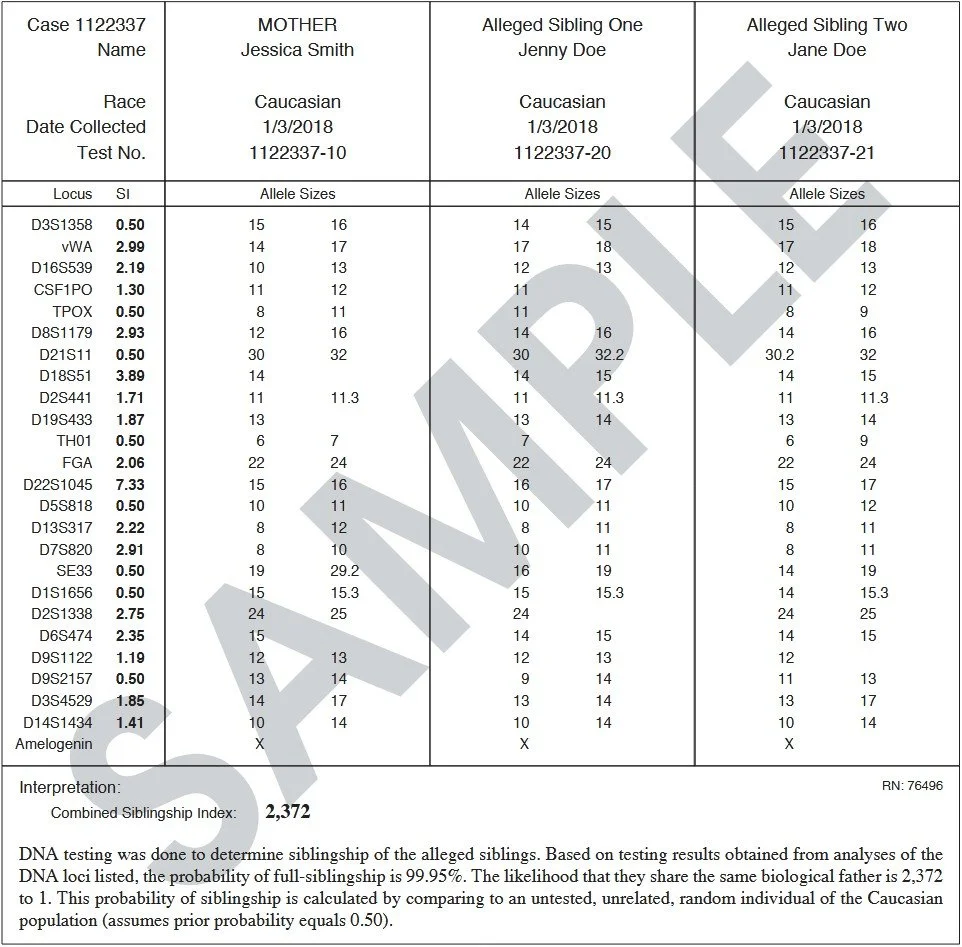
Example: Full Sibling Relationship Supported
In this scenario, the shared genetic markers between the two individuals strongly support that they share both biological parents. The statistical analysis indicates a high likelihood that the individuals are full siblings.
Example: Full Sibling Relationship Not Supported
In some cases, the shared genetic markers do not support a full sibling relationship. The analysis may instead indicate that the individuals are more likely to be half siblings or that another biological relationship may exist.
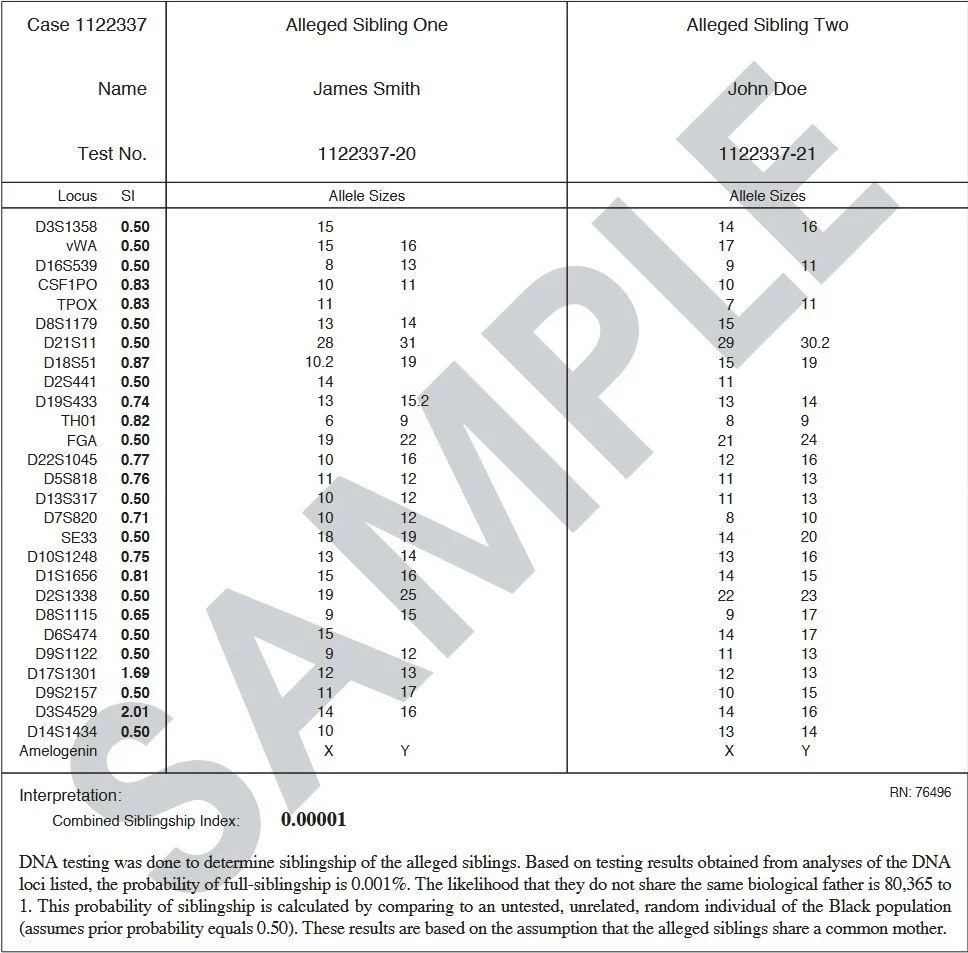
These examples help illustrate how laboratories interpret genetic evidence when evaluating sibling relationships.
Why Additional Participants Can Improve Accuracy
Sibling testing sometimes benefits from including additional family members in the analysis.
For example, including the biological mother in the test can help the laboratory isolate the DNA inherited from the father.
This additional information can improve the accuracy of the analysis and strengthen the statistical conclusions.
When Sibling DNA Testing Is Used
Sibling DNA testing is commonly used when a direct parent is not available for testing.
Situations where sibling testing may be helpful include:
Determining whether two individuals share the same father
Confirming biological relationships within families
Investigating family connections when a parent is unavailable
Clarifying family relationships discovered through ancestry testing
Sibling DNA testing provides a scientific method for evaluating these relationships.
In situations where direct cheek swab samples cannot be collected, some testing situations may involve the analysis of personal items that contain biological material.
Learn more about these types of samples here: What Items Can be Used for DNA Testing.
Differences Between Sibling Tests and Paternity Tests
Paternity testing is generally more direct because it compares a child’s DNA to the alleged father.
Sibling testing is more complex because it compares the DNA of two individuals without directly testing a parent.
Because of this, sibling DNA tests rely on statistical analysis of shared markers rather than a direct parent-child comparison.
Limitations of Sibling DNA Testing
Although sibling DNA tests are highly informative, there are some limitations.
For example:
DNA sharing can vary naturally between siblings
Half siblings and full siblings may sometimes share overlapping amounts of DNA
Additional relatives may improve the accuracy of the analysis
Because of these factors, laboratories rely on statistical calculations to interpret the results.
In some situations, sibling DNA test results may be inconclusive if the shared genetic markers fall within overlapping ranges between possible relationships.
Learn more about inconclusive DNA results here: What Do Inconclusive Results Mean.
Frequently Asked Questions
Can DNA testing always tell if two people are siblings?
DNA testing can determine the likelihood of a sibling relationship, but results are based on statistical analysis rather than absolute certainty.
Is including a know parent, usually a mother, recommended?
Yes, we highly recommend including a known parent of either, or both, of the siblings. This helps to lower the chance of an inconclusive result.
Can a sibling DNA test determine which parent is shared?
Not always. The test can determine whether individuals are likely to share one or both parents, but identifying the specific parent may require additional testing.
Is sibling DNA testing accurate?
Yes. Modern DNA testing analyzes many genetic markers to evaluate sibling relationships with a high degree of confidence.
Do both siblings need to provide DNA samples?
Yes. DNA samples from both individuals are required in order to compare genetic markers and evaluate the relationship.
Using DNA Testing to Understand Family Relationships
Sibling DNA testing can provide valuable insight when questions arise about biological relationships within a family. By analyzing shared genetic markers, laboratories can determine whether individuals are more likely to be half siblings or full siblings.
Understanding how these tests work helps families interpret their results and gain clarity about biological relationships.
