

Receiving a negative paternity test result can be confusing, especially when the DNA report shows several matching genetic markers between the child and the alleged father.
If the test concludes that the alleged father is not the biological father, why do some of the DNA markers still match? Does this mean the results are incorrect, or that there is still a possibility of paternity?
The short answer is that matching DNA markers do not automatically mean two people are biologically related. Even unrelated individuals can share certain genetic markers.
Understanding how paternity DNA testing works, what the markers represent, and how laboratories determine paternity can help explain why a test may show several matches but still report a 0% probability of paternity.
What Does a Negative Paternity Test Mean?
A negative paternity test, also called a paternity exclusion, means that the DNA evidence does not support the tested man being the biological father of the child.
When a laboratory reports a 0% probability of paternity, it means the alleged father has been excluded based on the genetic markers analyzed and the laboratory's interpretation criteria.
A negative result is different from a positive paternity test, which typically reports a probability of paternity greater than 99.9% when the genetic evidence strongly supports the biological relationship.
However, a negative result does not necessarily mean that none of the DNA markers match.
In fact, it is common for unrelated individuals to share some genetic markers.
How Does a Paternity DNA Test Work?
Paternity DNA testing compares specific regions of DNA inherited from biological parents.
Humans inherit approximately half of their autosomal DNA from their biological mother and half from their biological father.
Modern paternity tests typically examine multiple locations in the DNA known as Short Tandem Repeat (STR) markers, also called loci.
Each STR marker represents a specific location within the DNA where short genetic sequences repeat a certain number of times.
The number of repeats can vary from person to person, creating genetic differences that laboratories can use to evaluate biological relationships.
How DNA Markers Are Compared
At each autosomal STR location, a person generally has two genetic values, called alleles.
One allele is inherited from the biological mother, while the other is inherited from the biological father.
For example, a child's DNA profile might show the values 12 and 15 at a particular marker.
If the mother has values 10 and 12 at that location, the child may have inherited the 12 from the mother and the 15 from the biological father.
The laboratory compares these inherited patterns across numerous genetic markers to determine whether the alleged father is genetically consistent with being the biological father.
This comparison is performed across the complete set of markers analyzed, rather than relying on one or two matching locations.
Why Do DNA Markers Match on a Negative Paternity Test?
One of the most common misconceptions about paternity testing is that unrelated individuals should have completely different DNA profiles.
In reality, humans share most of their genetic information.
Even at the STR markers used in paternity testing, certain allele values are common throughout the population.
As a result, two unrelated people may share several matching markers simply by chance.
Matching DNA Markers Are Not Proof of Paternity
Imagine that a child and an alleged father share matching alleles at several STR locations.
At first glance, this may appear to support a biological relationship.
However, if the alleged father has genetic inconsistencies at multiple other markers that cannot reasonably be explained by normal inheritance or mutations, the laboratory may exclude him as the biological father.
The important factor is not simply how many markers match, but whether the complete genetic profile is consistent with biological inheritance.
This is why a negative paternity test can show numerous matching markers while still concluding that the alleged father is not the biological father.
What Do Matching and Non-Matching DNA Markers Look Like?
Consider the following simplified example.
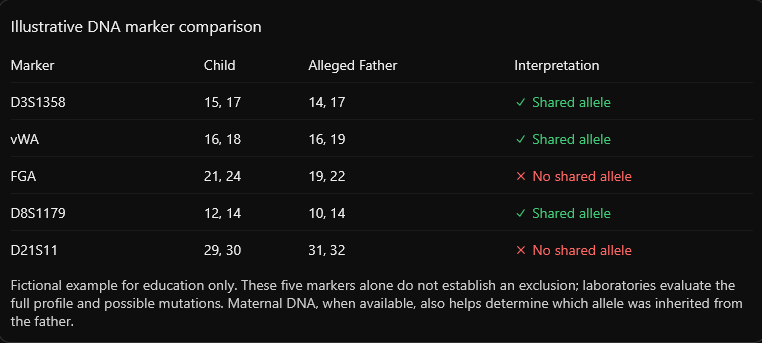
Using the above example, look at the D3S1358 marker in the comparison above. The child has alleles 15 and 17, while the alleged father has alleles 14 and 17.
Both individuals share allele 17, meaning the alleged father could potentially have passed that allele to the child. However, this match alone does not establish paternity.
Now look at the FGA marker. The child has alleles 21 and 24, while the alleged father has alleles 19 and 22.
In this example, the alleged father does not share either of the child's alleles, creating a genetic inconsistency that must be evaluated by the laboratory.
This is why a negative paternity test can show several matching DNA markers while still excluding the alleged father. Laboratories evaluate the complete genetic profile, including matching markers, inconsistencies, and the possibility of genetic mutations, before reaching a conclusion.
A single inconsistency does not automatically establish an exclusion because rare genetic mutations and other biological or technical factors can sometimes explain an unexpected result.
Multiple independent inconsistencies, however, can provide strong evidence against paternity.
For actual examples, visit our Example Paternity DNA Test Results page to compare positive and negative reports.
What Is a Paternity Index?
A paternity index (PI) is a statistical calculation used to evaluate how strongly the genetic evidence supports a claimed biological relationship at a particular marker.
The calculation considers the observed genetic information and how frequently certain alleles occur within relevant population data.
A marker that is common in the population may provide relatively little evidence supporting paternity, even when the child and alleged father share an allele.
A less common genetic pattern may provide stronger evidence.
The laboratory combines the statistical information from the tested markers to calculate a Combined Paternity Index (CPI).
The CPI is then used, together with an assumed prior probability, to calculate the reported probability of paternity.
This is why the final conclusion is based on the overall genetic evidence rather than simply counting matching markers.
Can a DNA Mutation Cause a Mismatch?
Yes. Genetic mutations can occasionally produce differences between a biological parent and child at an STR marker.
An STR mutation may occur when the number of repeated DNA sequences changes during transmission from parent to child.
For example, a biological father may have an allele with 14 repeats, but the child may inherit a version with 15 repeats.
Although the values differ, the difference may be explained by a mutation rather than an absence of biological relationship.
Because mutations are possible, laboratories do not necessarily exclude paternity based on a single mismatch.
When an unexpected inconsistency is detected, additional markers, mutation analysis, or further testing may be necessary to interpret the result.
A properly evaluated paternity exclusion takes these possibilities into consideration.
Does a 0% Probability of Paternity Mean the Test Is Wrong?
No. A reported 0% probability of paternity does not mean the test is incorrect simply because some DNA markers match.
When the laboratory determines that the alleged father is excluded, the result reflects the genetic inconsistencies identified during testing.
However, there are circumstances in which additional investigation may be appropriate.
These can include concerns about sample identification, an unexpected close biological relationship between the tested man and the actual father, or other unusual genetic circumstances.
If the result is unexpected, reviewing the report with the testing provider is a reasonable first step.
Depending on the situation, additional testing or a new collection may be recommended.
What If the Alleged Father Is Related to the Biological Father?
This is an important consideration when interpreting paternity results.
If the tested man is a close biological relative of the actual father, such as his brother or father, the individuals may share more genetic markers than two unrelated men.
This can create more genetic similarities between the alleged father and child.
For example, two biological brothers inherit DNA from the same parents and may share many STR alleles.
If one brother is the biological father and the other is tested, the tested brother may show more matching markers with the child than an unrelated individual would.
In these situations, additional genetic markers or testing of other family members may help distinguish the possible relationships.
If the alleged father is closely related to another potential father, it is important to inform the laboratory before testing.
How to Read a Negative Paternity DNA Test Result
Most paternity DNA test reports include a table showing the genetic markers analyzed and the corresponding allele values for each participant.
When reviewing a negative result, focus on the following information:
Genetic markers or loci: The specific DNA locations analyzed by the laboratory.
Allele values: The genetic values reported for the child, alleged father, and mother if included.
Genetic inconsistencies: Locations where the alleged father's genetic information is not consistent with the child's expected inheritance.
Paternity index: Statistical information used to evaluate the genetic evidence.
Final conclusion: The laboratory's interpretation of whether the alleged father is included or excluded.
The final conclusion is the most important part of the report.
Although the individual marker values can help explain the findings, they should not be interpreted independently of the laboratory's analysis.
Our Example Paternity DNA Test Results page provides sample reports to help you understand how the information is presented.
Should You Retest After a Negative Paternity Result?
A properly performed paternity test that clearly excludes the alleged father generally does not need to be repeated simply because some genetic markers match.
However, retesting may be appropriate if there are legitimate concerns about sample collection, participant identification, or the possibility that the wrong samples were submitted.
For personal testing, samples are typically collected at home without independent identity verification.
If the results will be used in court or another legal proceeding, Legal Paternity DNA Testing uses documented identity verification and chain-of-custody procedures.
If you are uncertain about your results, it is best to discuss the specific report with the testing provider before ordering additional testing.
Understanding Your Paternity DNA Test Results
A negative paternity test can show several matching DNA markers because many STR alleles are shared among unrelated individuals.
Matching markers alone do not establish paternity. The laboratory must evaluate the complete genetic profile, inherited allele patterns, statistical evidence, and any relevant genetic inconsistencies.
A properly interpreted negative result means that the alleged father has been excluded based on the DNA evidence.
If you would like to better understand how paternity results are calculated, read our Complete Guide to Paternity DNA Testing.
At Validity Genetics, we provide home and legal paternity DNA testing through our laboratory partners and can help explain the different testing options available.
For questions about paternity DNA testing or additional relationship testing, contact Validity Genetics or email Info@ValidityGenetics.com.
