
How to Read Paternity DNA Test Results
Quick Answer: How Do You Read a Paternity DNA Test Result?
Paternity DNA test results compare genetic markers between a child and an alleged father. The results show whether the alleged father is excluded as the biological father or included with a calculated probability of paternity based on statistical analysis.
What Information Appears on a Paternity DNA Test Report?
A paternity DNA test report typically contains several important pieces of information used to interpret the results.
These may include:
DNA profiles for each tested individual
Genetic markers analyzed during testing
The Combined Paternity Index (CPI)
The Probability of Paternity
A final conclusion indicating inclusion or exclusion
These values help scientists determine whether the tested man is the biological father.
Genetic Marker Comparison
DNA testing compares specific genetic markers between the child and the alleged father.
Each child inherits:
One genetic marker from the biological mother
One genetic marker from the biological father
When comparing DNA profiles, laboratories evaluate whether the alleged father could have contributed the paternal marker at each tested location.
If the alleged father does not match the required markers, he is excluded as the biological father.
What Is the Combined Paternity Index (CPI)?
The Combined Paternity Index (CPI) is a statistical value used to measure how strongly the genetic evidence supports biological fatherhood.
Each genetic marker tested produces a Paternity Index, which measures how likely it is that the alleged father passed that marker to the child.
All of these individual values are multiplied together to produce the Combined Paternity Index.
Higher CPI values indicate stronger genetic support that the tested man is the biological father.


What Is the Probability of Paternity?
The Probability of Paternity converts the Combined Paternity Index into a percentage that is easier to interpret.
This value represents how likely it is that the tested man is the biological father compared to an unrelated individual from the population.
Typical interpretation ranges include:
99% or greater
Considered scientifically conclusive evidence of biological fatherhood.
Most confirmed paternity results fall between 99% and 99.999% probability.
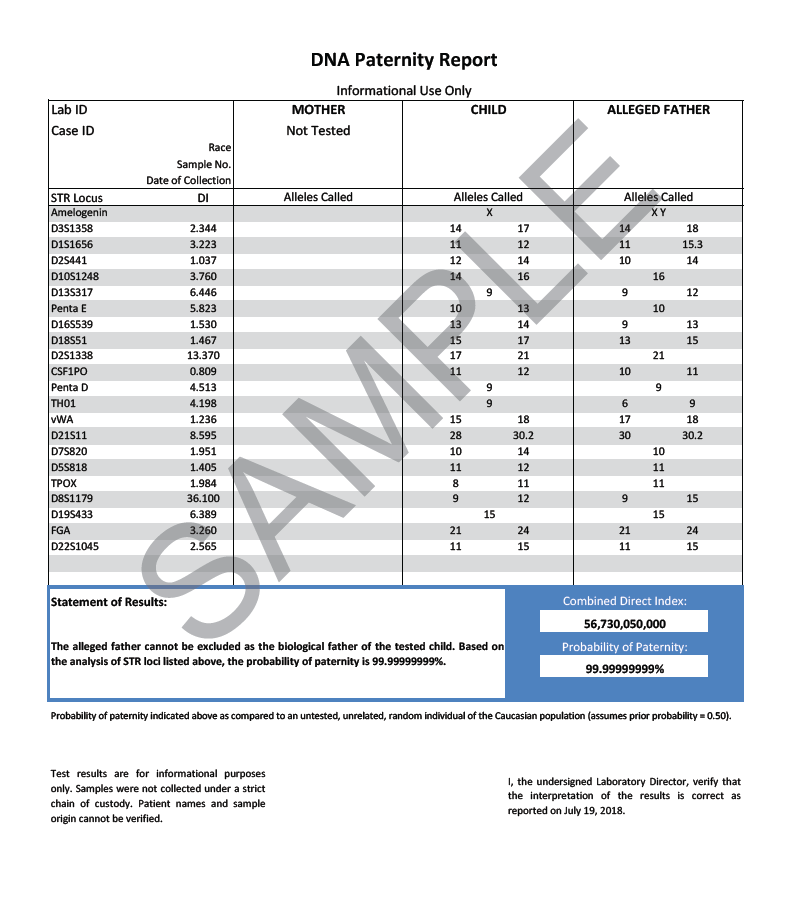
Example of a Positive Paternity Result (Inclusion)
When the tested man is the biological father, the genetic markers between the alleged father and child match in a way that is consistent with inheritance.
In these cases, the laboratory will calculate a high Combined Paternity Index (CPI) and a Probability of Paternity.
A paternity test report will usually include wording such as:
“The alleged father cannot be excluded as the biological father of the tested child.”
This statement means the genetic evidence supports that the tested man is the biological father.
For example, a report may show:
Combined Paternity Index (CPI): 2,356
Probability of Paternity: 99.96%
These values indicate that the genetic evidence strongly supports the conclusion that the tested man is the biological father.
Positive Paternity result
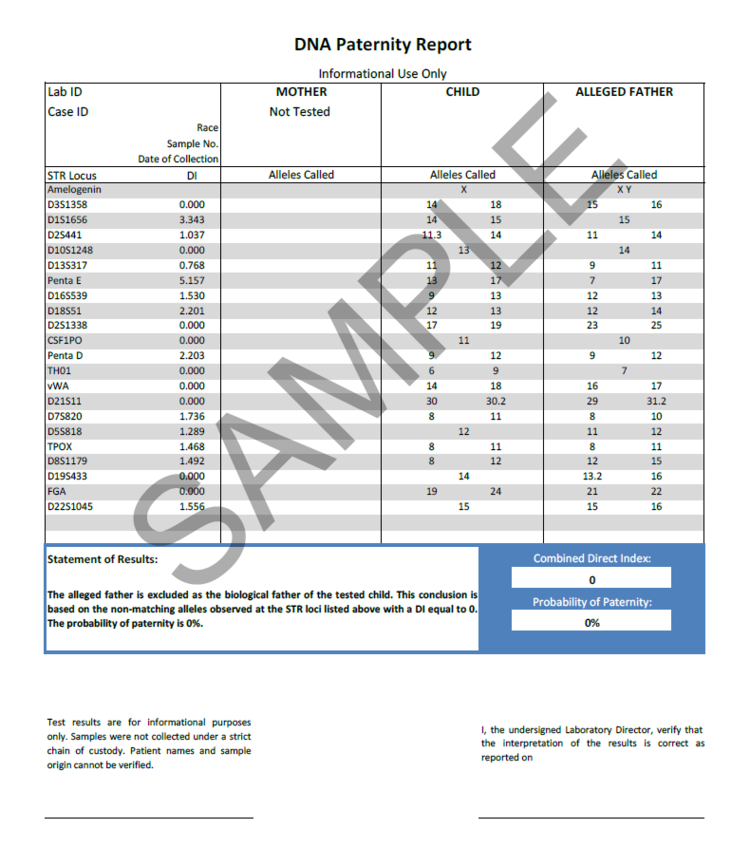
Example of a Negative Paternity Result (Exclusion)
An exclusion occurs when the alleged father does not share the necessary genetic markers required to be the biological father.
Because a child must inherit one genetic marker from each biological parent, multiple mismatches between the alleged father and the child will lead to an exclusion.
When this occurs, the laboratory will report wording such as:
“The alleged father is excluded as the biological father of the tested child.”
This means that the genetic markers do not match in a way that would allow the tested man to be the biological father.
In these situations, the report will typically show:
Probability of Paternity: 0%
Multiple genetic marker exclusions
Because the required inheritance pattern is not present, the laboratory can confidently determine that the tested man is not the biological father.
What Real Paternity Test Results Look Like
Below are examples of paternity DNA test report sections showing both an inclusion result and an exclusion result.
These examples demonstrate the statistical values and wording laboratories use when reporting DNA testing conclusions.
Negative Paternity Result
Why Multiple Genetic Markers Are Tested
Modern DNA testing examines many genetic markers across the DNA profile.
Testing multiple markers increases accuracy and helps ensure that the results are scientifically reliable.
Because each marker must match the genetic inheritance pattern between the child and father, analyzing many markers greatly reduces the chance of an incorrect conclusion.
How Accurate Are Paternity DNA Tests?
Modern paternity DNA testing is extremely accurate.
When the alleged father is the biological father, the probability of paternity typically exceeds 99%, which is considered scientifically conclusive.
When the alleged father is not the biological father, the test will show a complete exclusion.
Learn more about how paternity testing works here: Paternity DNA Test Explained.
When Results May Be Less Clear
Most paternity tests produce clear results showing either inclusion or exclusion.
However, in rare situations involving more complex family relationships or unusual genetic patterns, additional analysis may be required.
Learn more about inconclusive DNA results here: Inconclusive DNA Test Results.
Understanding DNA Test Results
Paternity DNA testing uses advanced genetic analysis to determine biological relationships with a very high level of confidence.
By comparing genetic markers and applying statistical calculations such as the Combined Paternity Index and Probability of Paternity, laboratories can determine whether a tested man is the biological father of a child.
Understanding how to read these results helps individuals interpret their reports and gain clarity about the conclusions provided by the laboratory.

Home Paternity DNA Test includes:
Easy to follow instructions
2 sterile buccal collection swabs per person
Sample envelopes for each person involved
Consent form
Prepaid return label to our laboratory. (USA Only)
Select from test options below: