

Understanding DNA Test Reliability
Are home paternity tests accurate? It's one of the most common questions people ask before purchasing a DNA testing kit.
When you're trying to establish whether someone is the biological father of a child, accuracy matters. The results may answer questions you've had for years, influence important family decisions, or provide much-needed peace of mind.
The good news is that laboratory-based home paternity DNA tests can be extremely accurate when samples are collected correctly and analyzed by a qualified laboratory.
At Validity Genetics, our at-home paternity tests are processed through accredited laboratory partners using established genetic testing methods.
But what does accuracy actually mean in paternity testing? And are home DNA tests as reliable as legal paternity tests?
Let's take a closer look.
How Accurate Is an At-Home Paternity DNA Test?
Modern paternity DNA testing compares genetic markers from a child and an alleged biological father to determine whether the genetic evidence supports or excludes the proposed relationship.
When testing produces a clear result, a paternity report will typically indicate either:
Exclusion: The genetic evidence does not support the alleged father being the child's biological father.
Inclusion: The genetic evidence supports the alleged father being the child's biological father, usually with a probability of paternity of 99.9% or higher.
A probability of paternity of 99.99% or greater is possible in many cases, but the actual percentage depends on the genetic information obtained and the statistical calculations performed.
Importantly, a high probability of paternity is not the same as a guarantee of 100% certainty. Paternity testing uses genetic evidence and statistical analysis to evaluate the proposed biological relationship.
For most customers, a properly performed laboratory-based home paternity test provides highly reliable information about biological fatherhood.
How Does a Home Paternity Test Determine Accuracy?
To understand the accuracy of paternity testing, it helps to know how the laboratory analyzes DNA.
A child inherits approximately half of their autosomal DNA from their biological mother and half from their biological father.
Paternity testing examines specific locations in the DNA called genetic markers, commonly short tandem repeats (STRs).
The laboratory compares these markers between the child and alleged father to determine whether the observed genetic patterns are consistent with biological inheritance.
What Happens During Laboratory Testing?
The process generally includes:
DNA extraction: Genetic material is recovered from the submitted cheek swab samples.
DNA profiling: The laboratory examines genetic markers used in relationship testing.
Profile comparison: The child's genetic markers are compared against those of the alleged father.
Statistical analysis: The laboratory calculates the strength of the genetic evidence supporting the proposed relationship.
Results review: The findings are reviewed and prepared for the final DNA test report.
The laboratory may examine additional genetic markers when necessary to clarify the results.
This process allows the laboratory to evaluate biological paternity using established scientific methods rather than relying on physical resemblance, blood type, or family history.
Are At-Home Paternity Tests as Accurate as Legal Paternity Tests?
Yes. A laboratory-based home paternity test can use the same DNA analysis methods as a legal paternity test.
At Validity Genetics, both informational and legal relationship testing are performed through qualified laboratory partners using established testing procedures.
The primary difference between home and legal paternity testing is not necessarily the laboratory's ability to analyze DNA. Instead, it involves how the samples are collected, how participant identities are verified, and whether the results can be used for legal purposes.
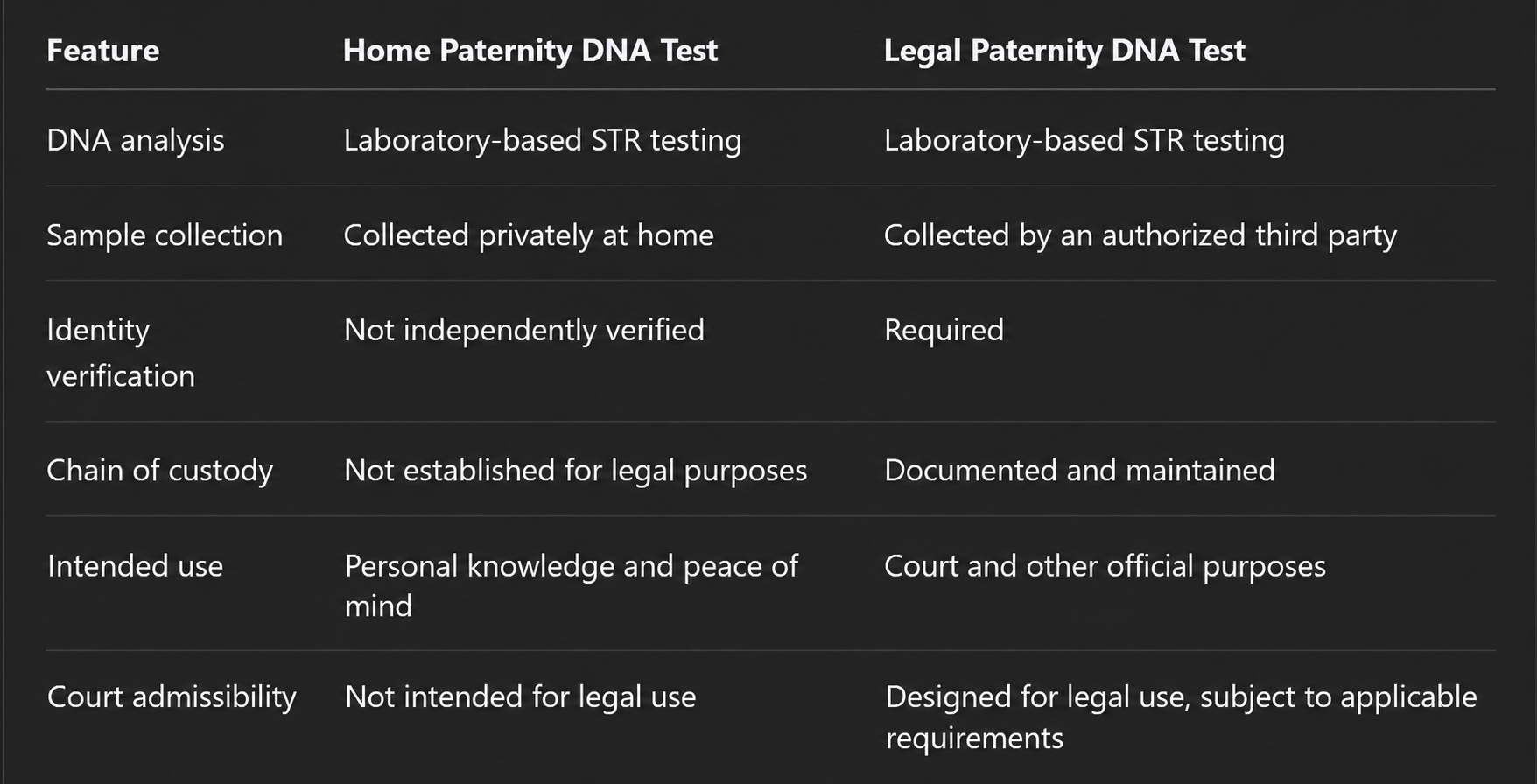
Home and legal paternity DNA tests can use the same laboratory methods. The primary differences involve sample collection, identity verification, and legal admissibility.
Why Does Legal DNA Testing Require a Chain of Custody?
Legal paternity testing requires procedures that document who provided each sample and how the samples were handled.
This typically includes identity verification, supervised collection, specimen labeling, and documented transfers to the laboratory.
These safeguards help establish that the DNA samples came from the identified participants.
With at-home testing, the laboratory can accurately analyze the DNA it receives, but it cannot independently verify who collected or provided those samples.
That's why an at-home paternity test should not be substituted for a legal test when results are needed for child support, custody, birth certificate changes, or other official matters.
Learn more about Legal Paternity DNA Testing.
What Can Affect the Accuracy of a Home Paternity Test?
Although modern DNA analysis is highly reliable, several factors can affect the quality or interpretation of a paternity test.
1. Incorrect Sample Collection
Home paternity tests generally use oral cheek swabs, also called buccal swabs.
These collect cells from the inside of the mouth that contain DNA.
If a swab is not rubbed against the cheek properly, it may collect too few cells for testing.
Following the collection instructions helps ensure the laboratory receives sufficient biological material.
2. Sample Contamination or Mix-Ups
Touching the collection tip, mixing swabs between participants, or placing samples in incorrectly labeled envelopes can create problems.
Contamination may introduce additional DNA, while sample mix-ups can lead to results that do not reflect the intended participants.
The laboratory can analyze the DNA submitted, but an at-home test cannot independently confirm the identity of the person who provided it.
For this reason, careful collection and labeling are especially important.
3. Improper Sample Storage
DNA samples should be properly dried and packaged before shipping.
Excessive moisture, heat, and poor storage conditions can contribute to DNA degradation.
Most home collection kits provide designated envelopes and packaging designed to protect the samples during transportation.
4. Testing Close Biological Relatives
Paternity testing can become more complicated when two possible fathers are closely related.
For example, if the alleged fathers are brothers, they may share more genetic markers than unrelated men.
In these situations, the laboratory should be informed before testing so the appropriate analysis can be considered.
Testing additional individuals or genetic markers may be recommended.
5. Unusual Genetic Findings
Occasionally, genetic mutations or other uncommon circumstances can complicate the interpretation of a paternity test.
Qualified laboratories use established procedures to evaluate these findings and determine whether additional testing is appropriate.
These situations are uncommon, but they help explain why DNA testing relies on both genetic comparisons and statistical interpretation.
What Does 99.99% Probability of Paternity Mean?
A paternity report may show a probability of paternity such as 99.9%, 99.99%, or higher.
These percentages describe the statistical strength of the genetic evidence supporting the alleged father's biological relationship to the child, under the assumptions used in the calculation.
For example, a reported 99.99% probability of paternity indicates very strong genetic support for the alleged father being the biological father.
However, the percentage should not be interpreted as a direct measurement of laboratory accuracy or as a guarantee that sample identities were correctly represented.
What Is the Combined Paternity Index (CPI)?
The Combined Paternity Index, or CPI, is another important figure commonly included in paternity DNA test results.
It represents how strongly the observed genetic evidence supports the alleged father being the biological father compared with an unrelated alternative father under the statistical model used.
The CPI is then used, together with an assumed prior probability, to calculate the reported probability of paternity.
A higher CPI generally indicates stronger genetic support for the proposed relationship.
For a more detailed explanation, read our guide to Understanding Paternity DNA Test Results.
Can a Home Paternity Test Be Wrong?
A properly conducted laboratory-based paternity test is highly reliable, but no testing process is completely free from the possibility of error.
Potential problems include incorrect sample identification, sample contamination, administrative errors, or unusual genetic circumstances.
Importantly, an inaccurate conclusion caused by submitting a sample from the wrong individual is different from an error in the laboratory's genetic analysis.
The best way to reduce these risks is to use a qualified laboratory, follow the collection instructions carefully, and ensure that all samples are correctly identified.
If the results are unexpected or inconsistent with other information, contact the testing company to discuss whether further analysis or a new collection is appropriate.
Does the Mother Need to Participate in a Home Paternity Test?
No. In most cases, a paternity DNA test can be performed using samples from only the child and alleged father.
This is commonly called a motherless paternity test.
However, including the biological mother's DNA can provide additional information by helping the laboratory identify which genetic markers the child inherited from her.
Her participation may be particularly useful when the results require further clarification or when the alleged fathers are closely related.
For routine direct paternity testing, the mother is generally not required.
Are At-Home Paternity Tests Accurate for Babies and Young Children?
Yes. DNA testing can be performed at any age, including shortly after birth.
A baby's DNA contains the genetic information needed for paternity analysis, and age does not make the genetic comparison inherently less reliable.
For newborns and young children, a cheek swab is generally used to collect DNA.
The collection process is noninvasive and usually takes only a few minutes.
Parents should follow the kit instructions carefully, particularly regarding feeding and the recommended waiting period before sample collection.
What If the Alleged Father Cannot Provide a Cheek Swab?
Sometimes the alleged father is deceased, unavailable, or unwilling to participate in conventional paternity testing.
In these situations, other DNA testing options may be available.
Forensic Paternity DNA Testing
Forensic Paternity DNA Testing attempts to recover DNA from a personal item associated with the alleged father.
Examples include toothbrushes, hair with roots, used tissues, and other biological materials.
If a suitable DNA profile is recovered, the laboratory may be able to perform a direct paternity comparison.
However, non-standard samples can contain degraded, insufficient, or mixed DNA, and successful recovery cannot be guaranteed.
Testing Other Biological Relatives
When the alleged father's DNA is unavailable, indirect relationship testing may help investigate paternity.
Possible options include:
These tests evaluate different biological relationships and may not provide the same level of certainty as a direct paternity test.
Read our article on Paternity Testing When the Father Isn't Available for a detailed explanation of these alternatives.
How Long Does an At-Home Paternity Test Take?
At Validity Genetics, standard home paternity DNA test results are generally available within 2–3 business days after all required samples are received and checked in at the laboratory.
Business days are Monday through Friday, excluding weekends and holidays.
Shipping time and delays caused by missing samples or incomplete information are not included in this timeframe.
Forensic paternity testing involving non-standard samples generally requires 5–7 business days after laboratory receipt and check-in.
Rush testing may be available for eligible services when arranged before laboratory processing begins.
Completed results are delivered electronically as a PDF document to the purchaser.
Frequently Asked Questions About Home Paternity Test Accuracy
Are home paternity tests 100% accurate?
Laboratory-based home paternity tests can provide extremely strong evidence of biological fatherhood, but a probability of paternity is a statistical conclusion rather than a guarantee of absolute certainty.
The reliability of the results also depends on the correct individuals providing the samples.
Are cheap paternity tests less accurate?
Not necessarily. Price alone does not determine the quality of a DNA test.
The laboratory's testing methods, quality controls, qualifications, and sample handling procedures are more meaningful considerations than price by itself.
Is a home paternity test as reliable as a court-admissible test?
The underlying genetic analysis can be equally reliable when the same validated laboratory methods are used.
The major distinction is that legal testing requires verified identities and documented chain-of-custody procedures, while at-home testing does not.
Can a home paternity test give a false positive?
Incorrect conclusions are possible, although uncommon with properly performed laboratory testing.
Sample misidentification, contamination, unusual genetic circumstances, or closely related potential fathers can complicate interpretation.
If you have concerns about a result, discuss them with the laboratory or testing provider.
Can a home paternity test give a false negative?
An incorrect exclusion is possible in unusual circumstances, including sample mix-ups or rare genetic findings.
Qualified laboratories evaluate unexpected marker differences and may recommend additional testing when appropriate.
Is a paternity test more accurate if the mother participates?
Including the biological mother's DNA can provide additional genetic information and may strengthen the analysis.
However, most routine paternity tests can be performed using only the child and alleged father.
Can I use home paternity test results in court?
At-home paternity results are intended for personal information and are generally not accepted as legally admissible evidence because the participants' identities and sample collection were not independently verified.
If results are needed for court or another official purpose, arrange a Legal Paternity DNA Test.
Choosing a Reliable Home Paternity DNA Test
When you're looking for answers about biological paternity, choosing a reliable DNA testing service is important.
A laboratory-based home paternity test can provide highly informative results when the correct individuals are tested, samples are collected properly, and established laboratory procedures are followed.
At Validity Genetics, we work with accredited laboratory partners to provide paternity and relationship DNA testing services, with clear reporting and support throughout the testing process.
Whether you're considering an At-Home Paternity DNA Test or need a Legal Paternity DNA Test, we can help you understand the differences and choose the appropriate option.
If you have questions about accuracy, sample collection, or interpreting results, contact Validity Genetics.
Our team can help you understand your testing options and what to expect from your results.
