
Choosing a DNA testing company involves evaluating laboratory accreditation, testing methods, privacy, and customer support.
Choosing a DNA testing company is an important decision, especially when the results could answer personal questions about paternity, family relationships, or possible infidelity.
With so many DNA testing companies offering similar services, how do you know which one to trust?
While price and turnaround time are important, they shouldn't be the only factors you consider. Laboratory accreditation, testing options, sample handling, privacy, and customer support all play a role in finding the right provider.
At Validity Genetics, we believe customers should understand what to look for before purchasing a DNA test.
Here are seven important things to consider when choosing a DNA testing company.
1. Look for an Accredited DNA Testing Laboratory
One of the most important factors when selecting a DNA testing company is the laboratory performing the actual analysis.
Accreditation demonstrates that a laboratory has been independently assessed against recognized standards for its testing activities.
Depending on the type of DNA testing, relevant accreditations may include:
AABB accreditation: Particularly important for relationship DNA testing, including certain legal and immigration testing applications.
ISO/IEC 17025 accreditation: Demonstrates technical competence for specified laboratory testing activities.
Other recognized accreditations: Depending on the laboratory and testing services provided, additional accreditations may apply.
It's important to understand that accreditation applies to the specific laboratory and its approved testing scope, not automatically to every company that sells DNA testing services.
Validity Genetics works with qualified, accredited laboratory partners to provide our DNA testing services.
Tip: Before purchasing a DNA test, ask which laboratory performs the testing and whether its accreditation covers the type of analysis you need.
2. Choose a Company That Offers the Right DNA Test
Not every DNA testing company offers the same services.
Some focus primarily on paternity testing, while others provide a broader range of relationship, forensic, or specialized DNA testing options.
Choosing a provider with experience in your particular testing situation can help you avoid purchasing the wrong service.
Paternity DNA Testing
Paternity DNA Testing determines whether an alleged father is the biological father of a child.
Testing is available for personal knowledge or, through a properly documented collection process, legal purposes.
Relationship DNA Testing
When direct paternity testing isn't possible, other family members may be able to help establish biological relationships.
Validity Genetics offers:
These tests use different genetic approaches, and some relationships are more difficult to establish conclusively than others.
Infidelity DNA Testing
Infidelity DNA Testing involves analyzing personal items or biological stains for the presence of DNA or specific bodily fluids.
Available services include:
These services answer different questions. For example, detecting semen on an item is not the same as identifying or comparing a DNA profile.
A knowledgeable provider should explain these distinctions before you order.
Forensic Relationship DNA Testing
Sometimes a person cannot provide a standard cheek swab because they are unavailable, deceased, or unwilling to participate.
Forensic Relationship DNA Testing may allow DNA to be recovered from personal items such as toothbrushes, hair with roots, or biological stains.
However, not every item contains enough usable DNA for testing, and privately collected forensic samples are not suitable for standard court-admissible testing.
3. Understand the DNA Testing Methods and Accuracy
DNA testing accuracy is another important consideration.
Modern relationship DNA testing commonly examines genetic markers called short tandem repeats (STRs). These markers are compared to evaluate whether individuals share the expected genetic patterns for a particular biological relationship.
For paternity testing, results generally provide either an exclusion or a calculated probability of paternity.
A probability of 99.99% or higher may be reported in strongly supportive cases, but the exact result depends on the genetic evidence and statistical calculations.
Other relationship tests, such as sibling or grandparent testing, may be less conclusive because the relationships are more distant or indirect.
A reputable DNA testing company should explain:
What type of genetic testing will be performed
What the results can establish
Whether additional family members could improve the analysis
Whether inconclusive results are possible
What limitations apply to non-standard samples
Be cautious of any company that promises a conclusive result in every situation. Some tests cannot provide a definitive answer, even when the laboratory analysis is performed correctly.
For more information, read our guide to Home Paternity DNA Test Accuracy.
4. Check the Company's Experience With Different DNA Samples
Many DNA tests use cheek swabs because they are convenient, reliable, and easy to collect.
However, not every testing situation involves a standard sample.
Specialized testing may require analysis of:
Toothbrushes and other personal hygiene items
Clothing or fabric stains
Dried blood or saliva
Hair containing roots
Other items that may contain biological material
These samples can present additional challenges, including contamination, degraded DNA, low DNA quantities, or mixtures from multiple people.
An experienced provider should help you determine whether an item is appropriate for testing and explain that DNA recovery cannot be guaranteed.
Validity Genetics offers specialized testing options for non-standard samples, including forensic relationship testing and infidelity DNA analysis.
You can learn more in our articles about Common Types of DNA Samples and How to Prepare for DNA Testing.
5. Compare Pricing, Turnaround Times, and Testing Options
When comparing DNA testing companies, don't focus exclusively on the advertised starting price.
Make sure you understand what is included in the service.
Questions worth asking include:
How many participants or samples are included?
Are there additional charges for non-standard samples?
Is professional collection required?
Are rush testing options available?
How will results be delivered?
Are additional DNA comparisons available if needed?
How Long Should DNA Testing Take?
Turnaround times vary depending on the test and the condition of the samples.
At Validity Genetics, our standard processing times are:
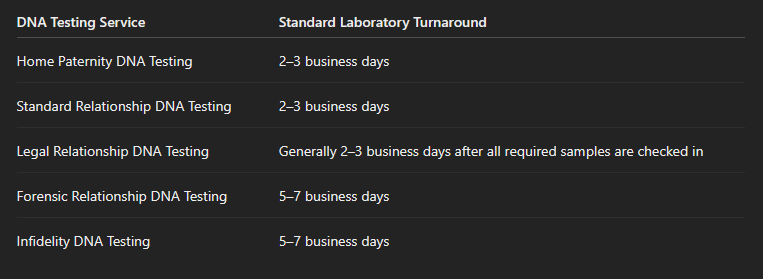
Standard DNA testing turnaround times at Validity Genetics range from 2–3 business days for relationship testing to 5–7 business days for forensic and infidelity testing, after laboratory check-in.
DNA Testing ServiceStandard Laboratory TurnaroundHome Paternity DNA Testing2–3 business daysStandard Relationship DNA Testing2–3 business daysLegal Relationship DNA TestingGenerally 2–3 business days after all required samples are checked inForensic Relationship DNA Testing5–7 business daysInfidelity DNA Testing5–7 business days
These estimates begin after the laboratory receives and checks in the required samples.
Business days are Monday through Friday, excluding weekends and holidays. Shipping times and collection scheduling are additional.
Rush testing may be available for eligible orders when arranged before laboratory processing begins.
For legal and immigration DNA testing, pricing depends on the specific test, number of participants, and collection requirements. Contact the provider for a personalized quote.
6. Make Sure Your DNA Results and Personal Information Are Handled Confidentially
DNA testing involves sensitive personal and genetic information.
Before choosing a company, review its privacy policy and ask how results are stored, delivered, and shared.
Important questions include:
Who can access the DNA test results?
Will results be shared with anyone other than the purchaser?
How long are DNA records retained?
Does the company sell customer information?
How are personal samples handled after testing?
At Validity Genetics, test results are delivered confidentially to the purchaser by email as a PDF unless other arrangements have been authorized.
We do not sell customers' personal information or DNA profiles. Relevant information is shared with laboratory partners as necessary to perform the requested testing services.
We also offer discreet collection options for customers who prefer not to receive a physical testing kit.
7. Look for Knowledgeable, Responsive Customer Support
DNA testing isn't always straightforward.
A customer may need help determining whether a toothbrush is suitable for testing, whether a sibling test can answer a paternity question, or whether a legal test is necessary.
These are situations where knowledgeable customer support makes a difference.
Before placing an order, consider contacting the company with a few questions.
Pay attention to whether the representative:
Explains testing options in understandable language
Discusses the limitations of different tests
Helps determine which samples may be suitable
Provides clear information about costs and turnaround times
Offers practical guidance without promising results that cannot be guaranteed
At Validity Genetics, we recognize that every testing situation is different.
We work with customers to identify appropriate testing options, including specialized services that may not fit a standard DNA testing kit.
Our goal is to help customers make informed decisions before sending samples to the laboratory.
Why Choose Validity Genetics for DNA Testing?
Validity Genetics provides a broad range of DNA testing services for individuals seeking answers about biological relationships, personal concerns, and specialized forensic samples.
We focus on making the process understandable, accessible, and adaptable to each customer's needs.
Specialized Testing Options
Beyond standard paternity testing, we offer sibling, grandparent, avuncular, paternal lineage, infidelity, and forensic relationship DNA testing.
Accredited Laboratory Partners
Our testing services are performed through qualified laboratory partners with applicable accreditations and established laboratory procedures.
Personalized Assistance
We help customers understand their testing options, sample requirements, and possible limitations before ordering.
Convenient Sample Collection
Many of our informational relationship tests use easy-to-collect cheek swabs. We also offer options for customers who need to submit non-standard samples or prefer electronic collection instructions.
Clear Turnaround Times
We provide estimated laboratory processing times and communicate expected completion dates after samples are checked in.
Confidential Results
We take customer privacy seriously and provide DNA testing results directly to the purchaser unless written authorization allows another recipient.
Frequently Asked Questions About Choosing a DNA Testing Company
How do I know if a DNA testing company is reputable?
Look for transparent information about the laboratory performing the testing, relevant accreditations, testing methods, privacy practices, and customer support.
A reputable provider should also explain what its tests can and cannot determine.
Does the DNA testing laboratory need to be accredited?
Accreditation is an important quality indicator, especially for legal relationship and immigration DNA testing.
The required accreditation depends on the test and its intended use. For personal informational testing, accreditation can still provide additional confidence in the laboratory's competence.
Are all DNA testing companies equally accurate?
Not necessarily. Testing methods, laboratory procedures, sample quality, and interpretation can vary.
The type of relationship being tested also matters. A direct paternity test generally provides stronger statistical evidence than some indirect relationship tests.
Can I use an at-home DNA test for court?
At-home DNA tests are generally intended for personal knowledge and do not establish a documented legal chain of custody.
If you need results for court or another official purpose, review our guide to Home vs. Legal DNA Testing.
What if I'm unsure which DNA test I need?
Contact the testing provider and explain the biological relationship you're trying to establish, who is available for testing, and whether the results are needed for personal or legal purposes.
These details can help determine which test is appropriate.
Can a DNA testing company identify someone from an unknown DNA sample?
A DNA laboratory may be able to develop a profile from an unknown sample and compare it with a known reference sample.
However, private DNA testing services generally cannot identify an unknown individual simply by searching law enforcement DNA databases.
Choosing the Right DNA Testing Company Starts With Asking the Right Questions
Finding a DNA testing company you can trust means looking beyond the lowest price or fastest advertised turnaround time.
Accredited laboratory partners, appropriate testing methods, clear privacy practices, and knowledgeable customer support are all important.
Whether you need a straightforward paternity test or a more specialized forensic or infidelity DNA test, understanding your options can help you make the right decision.
Validity Genetics offers home, legal, relationship, infidelity, and forensic DNA testing services to help customers find the answers they're looking for.
If you have questions about which test is appropriate for your situation, contact Validity Genetics. Our team can help explain your options and the next steps.
