

Home and legal DNA tests can use the same laboratory methods, but legal testing requires identity verification and documented chain of custody.
Really, what is the Difference?
When considering a paternity or relationship DNA test, one of the first decisions you'll need to make is whether to choose an at-home DNA test or a legal DNA test.
Both types of testing can provide reliable information about biological relationships, but they serve different purposes.
An at-home DNA test, also called an informational DNA test, is designed for personal knowledge and peace of mind. A legal DNA test, sometimes called a court-admissible DNA test, follows additional procedures so the results can be used for court proceedings and other official purposes.
The biggest difference isn't necessarily how the DNA is analyzed. It's how the samples are collected, how identities are verified, and whether a documented chain of custody is maintained.
At Validity Genetics, we offer both informational and legal DNA testing through qualified, accredited laboratory partners.
Understanding these differences before ordering can help you choose the right test and avoid having to repeat the process later.
What Is an At-Home DNA Test?
An at-home DNA test allows individuals to collect their own DNA samples privately, without visiting a professional collection facility.
These tests are commonly referred to as:
Home DNA tests
Informational DNA tests
Private DNA tests
Peace-of-mind DNA tests
Most at-home relationship tests use a simple oral cheek swab, also called a buccal swab, to collect cells containing DNA.
After collecting the samples, participants package them according to the instructions and return them to the laboratory for analysis.
When Should You Choose an At-Home DNA Test?
At-home testing is generally appropriate when you want answers for personal reasons and do not need to submit the results to a court or government agency.
Common reasons include:
Determining whether a man is the biological father of a child
Investigating whether two individuals are biological siblings
Evaluating grandparent and grandchild relationships
Investigating aunt, uncle, niece, or nephew relationships
Exploring paternal ancestry through Y-STR DNA testing
Validity Genetics offers several informational relationship tests, including:
Advantages of At-Home DNA Testing
For customers who only need results for personal knowledge, at-home testing offers several advantages.
Convenience: Samples can be collected at home or another suitable private location.
Privacy: Participants can collect their samples without attending a professional collection appointment.
Affordability: Informational testing generally costs less because professional collection and legal documentation are not required.
Flexibility: Participants can collect samples at different times and locations. For eligible home relationship tests, Validity Genetics offers a Split Kit option when individuals live at separate addresses.
However, at-home testing has an important limitation.
Because the identities of participants are not independently verified, at-home DNA test results are not intended for legal use.
What Is a Legal DNA Test?
A legal DNA test is designed for situations where DNA results may be required by a court, government agency, or another official authority.
The genetic analysis may use the same established laboratory methods as an informational test, but legal testing requires additional safeguards to document the identity of each participant and the handling of their samples.
These safeguards are collectively known as the chain of custody.
When Is Legal DNA Testing Required?
Legal paternity and relationship DNA testing may be needed for:
Child custody or child support proceedings
Establishing or challenging legal paternity
Adding or changing a father's name on a birth certificate
Parental rights proceedings
Inheritance, trusts, and estate matters
Certain adoption-related matters
US immigration and visa applications
Other legal or administrative proceedings requiring verified biological relationships
The exact requirements depend on the court, agency, or organization requesting the results.
If your DNA test is connected to a legal matter, we recommend confirming the requirements before ordering.
Learn more about Legal DNA Testing and Legal Paternity DNA Testing.
What Is Chain of Custody in DNA Testing?
A chain of custody is a documented process used to establish who provided each DNA sample and how those samples were collected, handled, and transferred to the laboratory.
This documentation helps protect the integrity of the testing process.
Legal DNA testing generally includes:
Identity verification: Participants provide appropriate identification, such as a government-issued photo ID for adults.
Authorized sample collection: Samples are collected by an approved, impartial third party following the laboratory's procedures.
Documentation: Required forms, participant information, and collection records are completed.
Secure sample handling: Samples are properly labeled, sealed, and transferred according to the laboratory's chain-of-custody requirements.
Laboratory analysis: The samples are analyzed and the results are issued with the required legal documentation.
Who Can Collect Samples for a Legal DNA Test?
Legal DNA samples must be collected by an individual authorized under the laboratory's procedures.
Depending on the testing arrangement, this may include an approved medical professional or another qualified third-party collector.
Not every unrelated person automatically qualifies to collect legal DNA samples. The collector and collection procedure must meet the requirements of the laboratory and the authority requesting the test.
Validity Genetics can help customers understand the appropriate collection arrangements for eligible legal DNA testing services.
Can a Legal DNA Test Be Collected at Home?
Yes, in some circumstances.
The term legal DNA testing does not necessarily mean that collection must take place inside a laboratory or medical office.
An authorized collector may be able to perform the collection at a private location, provided the laboratory's identity verification, documentation, and chain-of-custody procedures are followed.
However, participants cannot simply collect their own samples and designate the results as legal.
The collection must be arranged and performed according to the applicable requirements.
This is an important distinction: a legal DNA test can sometimes be collected in a private setting, but it cannot be self-collected like an informational home DNA test.
Home vs. Legal DNA Testing: Side-by-Side Comparison
Both options can provide reliable genetic information, but the requirements and intended uses differ.
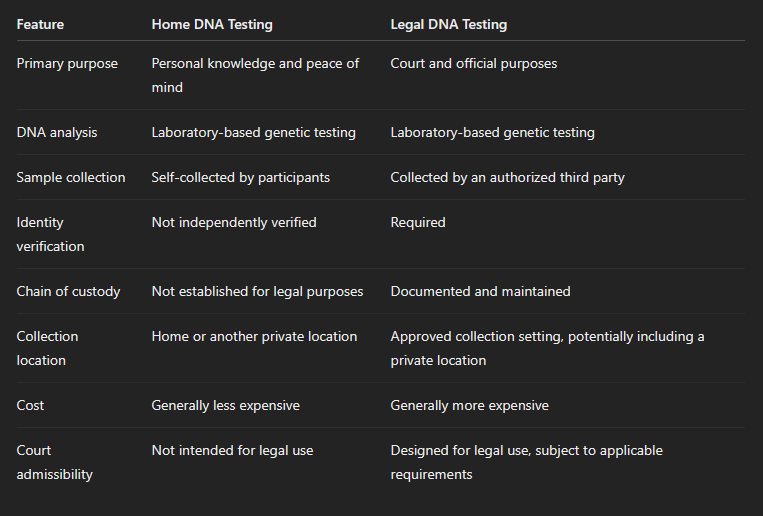
Home vs. Legal DNA Testing: Key Differences
Are Home DNA Tests as Accurate as Legal DNA Tests?
Yes. A properly performed laboratory-based home paternity test can use the same genetic testing methods as a legal paternity test.
The difference is that legal testing includes independent identity verification and documented sample handling.
With an at-home test, the laboratory can analyze the DNA it receives, but it cannot independently confirm who provided the samples.
For a detailed explanation, read our article How Accurate Are Home Paternity Tests?.
How Much Does Home vs. Legal DNA Testing Cost?
Cost is another important consideration when deciding between informational and legal DNA testing.
At-Home DNA Testing Costs
At-home relationship tests are generally more affordable because participants collect their own samples.
The total cost depends on the type of test, the number of participants, and any additional services selected.
Legal DNA Testing Costs
Legal DNA testing typically costs more because it requires identity verification, authorized sample collection, and chain-of-custody documentation.
At Validity Genetics, the final cost of legal DNA testing depends on the type of test and the specific sample collection requirements.
Additional charges may apply for professional collection, extra participants, specialized arrangements, or expedited services.
If you only need results for personal knowledge, an at-home test is usually the more economical choice.
However, if you anticipate needing the results for legal purposes, ordering a legal test from the beginning may prevent the expense of repeating the test later.
Contact Validity Genetics to discuss your testing needs and receive pricing based on your situation.
Can You Use an At-Home DNA Test in Court?
Generally, no.
At-home DNA test results are intended for personal information and are not designed to meet the chain-of-custody requirements associated with legally admissible testing.
Even when the laboratory analysis is reliable, the absence of independently verified identities means the results cannot establish who actually provided the samples to the same evidentiary standard.
If you complete an at-home test and later need court-admissible results, you will generally need to arrange a new legal DNA test with properly documented collection.
The final decision about admissibility belongs to the relevant court or authority.
What About Immigration DNA Testing?
DNA testing for immigration purposes has additional requirements that may differ from other legal DNA tests.
For certain US immigration cases, DNA testing must be performed through an appropriately accredited laboratory and follow procedures established by the requesting government agency.
Applicants cannot use an ordinary at-home DNA testing kit to satisfy these requirements.
The testing process may involve coordination between the laboratory, the applicant, and a US embassy or consulate.
If you need DNA testing for a family-based immigration or visa application, visit our US Immigration and Visa DNA Testing page before placing an order.
What If Someone Cannot Provide a Standard DNA Sample?
Sometimes a person is deceased, unavailable, or unwilling to provide a conventional cheek swab.
In these situations, forensic relationship DNA testing may offer an alternative.
Forensic Relationship DNA Testing attempts to recover DNA from non-standard samples, such as toothbrushes, hair with roots, or biological stains.
These samples may be useful for investigating paternity and other family relationships.
However, Validity Genetics' standard forensic relationship tests using privately collected personal items are informational and are not court-admissible.
If the results are needed for legal purposes, contact us before ordering to discuss whether an appropriate legally documented testing arrangement may be available.
How Long Do Home and Legal DNA Tests Take?
At Validity Genetics, standard relationship DNA testing generally takes 2–3 business days after all required samples have been received and checked in at the laboratory.
This timeframe applies to most standard home and legal relationship tests.
Forensic relationship DNA testing involving non-standard samples generally takes 5–7 business days after laboratory receipt and check-in.
Business days are Monday through Friday, excluding weekends and holidays.
Shipping, scheduling, and delays involving incomplete sample submissions are not included in these processing estimates.
Rush testing may be available for eligible services when arranged before laboratory processing begins.
Frequently Asked Questions About Home and Legal DNA Testing
What is the main difference between home and legal DNA testing?
The main difference is the collection process and intended use.
Home DNA testing allows participants to collect their own samples for personal knowledge. Legal DNA testing requires verified identities, authorized collection, and documented chain-of-custody procedures so the results can be used for official purposes.
Are legal DNA tests more accurate than home DNA tests?
Not necessarily. Both can use the same established laboratory analysis methods.
Legal testing provides additional assurance about participant identities and sample handling, rather than automatically producing more accurate genetic measurements.
Can I change my home DNA test into a legal DNA test?
An already completed home test generally cannot be converted into a legal test because its original sample collection did not follow legal chain-of-custody procedures.
A new, properly documented collection and testing arrangement will generally be required.
Do I have to go to a laboratory for legal DNA testing?
Not always. An authorized collector may be able to collect samples at another approved location, depending on the laboratory's procedures and the requirements of the requesting authority.
Is legal DNA testing required for child support?
If DNA results are needed as official evidence in a child support proceeding, a legal DNA test may be required.
Always confirm the specific requirements with the court or agency handling your case.
Can family members in different states complete a legal DNA test?
Yes, legal DNA testing can often be coordinated for participants living in different locations.
Each collection must follow the required identity verification and chain-of-custody procedures.
Is home DNA testing confidential?
Yes. Validity Genetics treats DNA testing information as confidential.
We do not sell customers' personal information, DNA profiles, or testing information. Information is shared only as necessary to provide the requested services or as otherwise required by law.
Test results are provided to the purchaser unless written authorization is received to release them to another individual.
Which DNA Test Should You Choose?
Choosing between home and legal DNA testing comes down to why you need the results.
If you're looking for answers about paternity or another biological relationship for personal knowledge, an at-home DNA test is generally the most convenient and affordable option.
If you need the results for court, child support, birth certificate changes, inheritance, or another official purpose, legal DNA testing is usually the appropriate choice.
At Validity Genetics, we offer both At-Home Paternity DNA Testing and Legal DNA Testing through qualified laboratory partners.
If you're unsure which test meets your needs, contact our DNA testing team before ordering.
We can help explain the differences, review your circumstances, and guide you toward the appropriate testing service.
